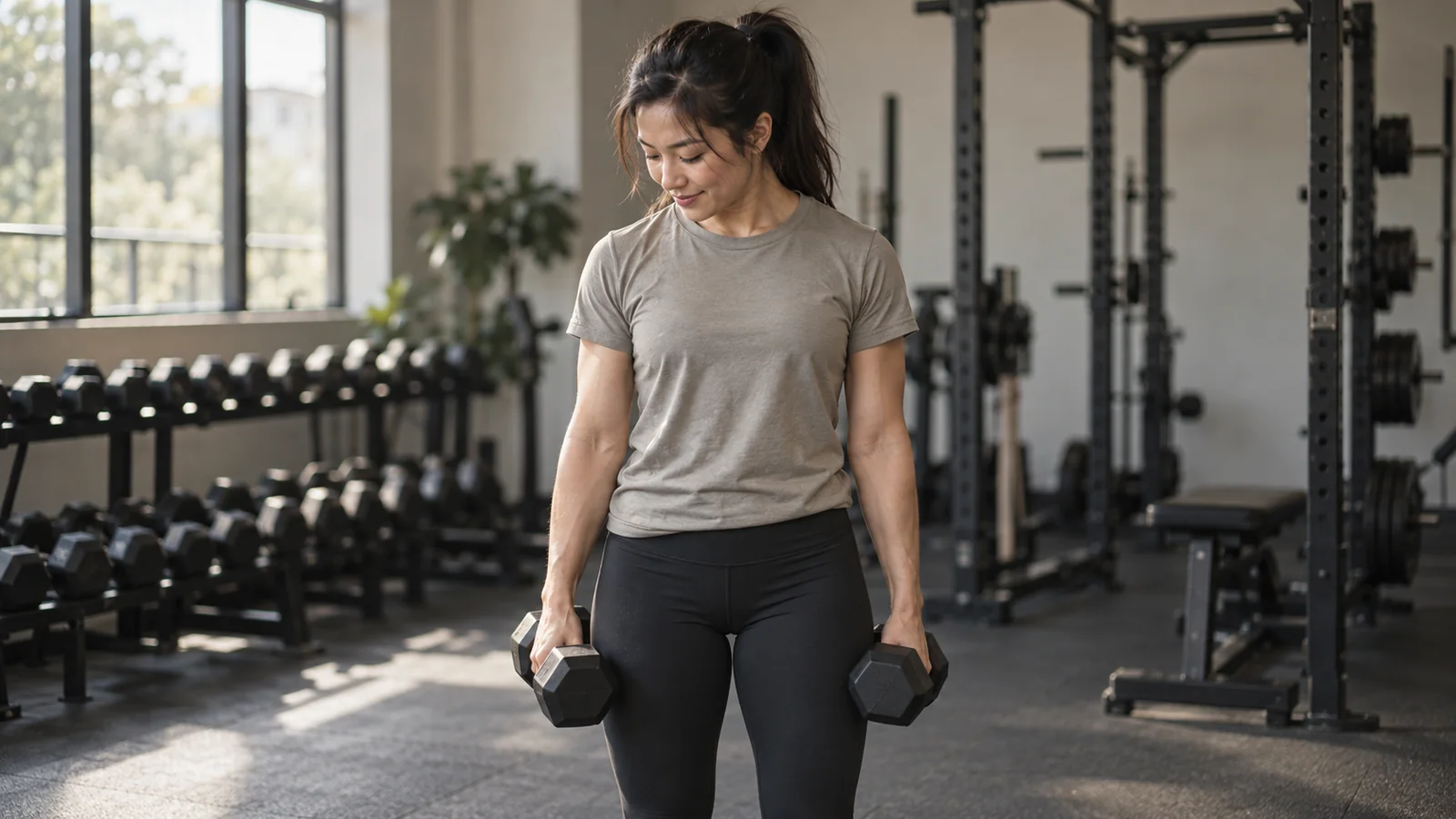
Follow the instruction for the specific exercise in your logging app. If you are making your own paper or spreadsheet log, a clear convention for paired upper-body exercises is to record the weight of one dumbbell, label it “per hand,” and record reps per arm. For a press with two 20 kg dumbbells moved together ten times, write “20 kg per hand × 10 reps.” Do not enter 20 reps just because both arms moved.
There is no single entry rule shared by every app and exercise. StrengthLog, for example, documents different weight entries for dumbbell presses and dumbbell lunges. Strong documents a setting that changes how dumbbell volume is counted on iOS. Those are reasons to read the field instructions before copying a number between apps.[1][2]
The number you enter and the volume you see are different things
Your load entry answers “which weight did I use?” A volume calculation combines that entry with repetitions and, in some systems, a multiplier for the two sides. A per-hand entry does not necessarily mean the app ignores the other hand. It may already account for both sides in its statistics.[1][2]
The following is an illustrative accounting example, not an observed workout. Suppose you press two 20 kg dumbbells for ten simultaneous reps. These three calculations explain why the same physical set can produce different numbers:
| Convention | Recorded value and calculation |
|---|---|
| Per-hand entry, no multiplier | Enter 20 kg × 10. The recorded load-volume is 200 kg. |
| Per-hand entry, two-side multiplier | Enter 20 kg × 10. The system calculates 20 × 10 × 2 = 400 kg. |
| Combined entry, no multiplier | Enter 40 kg × 10. The recorded load-volume is 400 kg. |
Trouble starts if you enter the combined 40 kg in a field that expects 20 kg and already applies the multiplier. The result becomes 40 × 10 × 2 = 800 kg. Nothing about the lifting changed; the accounting doubled it. Check the app’s definition rather than choosing whichever total looks more impressive.
A clear convention for your own workout log
For a log you design yourself, the convention below makes the equipment and completed reps explicit. These are recording choices for this example, not universal app rules. Put the convention in the exercise name or a dedicated column so a future entry cannot quietly change its meaning.
| Exercise example | Unambiguous entry |
|---|---|
| Dumbbell press | Two 20 kg dumbbells, 10 simultaneous reps: 20 kg per hand; 10 reps per arm. |
| Alternating curl | Two 10 kg dumbbells, 8 curls on each arm: 10 kg per hand; left 8, right 8. |
| One-arm row | One 24 kg dumbbell: left 10 reps, right 9 reps. Keep the two results separate. |
| Dumbbell lunge | Two 12 kg dumbbells, 8 reps per leg: 24 kg combined external load; left 8, right 8. |
| Goblet squat | One 20 kg dumbbell, 10 reps: 20 kg total external load; 10 reps. |
The lunge entry uses combined load because both dumbbells are being carried through each repetition. The word “combined” is doing important work: without it, a later reader could interpret 24 kg as the weight of each dumbbell. A goblet squat uses one dumbbell, so there is no second dumbbell to add.
If your app labels the exercise differently, use its convention instead. StrengthLog’s published instructions illustrate this exact distinction: its dumbbell press entry uses one dumbbell, while its dumbbell lunge entry uses the two dumbbells combined, with reps entered for one side.[1]
How to count alternating and one-sided reps
An alternating curl can be described as eight reps per arm or sixteen individual arm movements. Both descriptions identify the same sequence, but “16 reps” without a convention is ambiguous. The person reading it cannot know whether you completed sixteen on each side or sixteen in total.
In your own log, “L8 / R8” removes that ambiguity. If the exercise field in an app means reps per side, enter eight. If it means total alternating movements, enter sixteen. Keep that definition fixed for that exercise; do not switch according to how you happened to count during the set.
When the sides differ, preserve the difference. For example, write “24 kg: L10 / R9” for a one-arm row. Averaging that to 9.5 reps describes neither completed set. If your app cannot store separate sides, use a note or its documented unilateral workflow. Do not duplicate every set without checking whether the statistics already account for both sides.
What to do if you have been logging it the other way
First establish what the older entries mean. A history of 40 kg presses might represent two 20 kg dumbbells, two 40 kg dumbbells, or a mixture. The number alone cannot tell you. Use your notes, the exercise field instructions and any export that retains that context.
- Save a copy or export before editing old records, if your logging tool provides one.
- Choose the intended convention for each exercise, including how its reps are counted.
- Convert only entries whose original meaning you can establish. A known 40 kg combined entry becomes 20 kg per hand; an uncertain entry should stay marked uncertain.
- If you cannot safely normalize the history, start a clearly labeled series from a stated date. Keep the old series for reference.
- Recheck charts and personal records after the correction. A displayed record caused by a convention change is not a new lifting result.
Changing units is a separate operation. Converting pounds to kilograms does not decide whether a number represents one dumbbell or the pair. Preserve both pieces of information: the unit and the load convention.
Compare like with like before calling it progress
Imagine these two illustrative entries: session one says “20 kg per hand × 10”; session two says “40 kg combined × 10.” That is the same external load and repetition count. If you instead enter the second set as 40 kg per hand, a chart may show a large jump that came entirely from the label.
A more useful comparison is “20 kg per hand × 10” followed by “20 kg per hand × 11,” with the same exercise variation and recording convention. It records one more completed rep per arm. Whether that represents a lasting trend needs more context than a single pair of entries, including any changes in setup or execution.
The same caution applies to estimated maximums. Feeding twice the load into a formula that scales with load doubles its output. It does not demonstrate twice the strength. Our guide to estimated 1RM, volume and rep records works through what those metrics actually describe.
Is a 20 kg dumbbell 20 kg or 40 kg for the pair?
If each dumbbell is labeled 20 kg, the pair has 40 kg of combined external load. Which number belongs in a log depends on whether its field means per dumbbell or combined load. Write that meaning next to the number in a paper log.
Do I count ten dumbbell presses as twenty reps?
Ten simultaneous presses mean ten repetitions performed by each arm. For the per-arm convention used in this guide, log ten. Do not multiply both the weight and the reps to account for the same second dumbbell.
Can I compare dumbbell and barbell volume directly?
You can compare the arithmetic only after naming what each number includes. Matching external-load volume does not make two different exercises the same task. Keep their performance histories separate and avoid treating equal totals as evidence of equal difficulty or the same training effect.
The easiest way to make the next session readable is to settle the labels now. Our free workout-log template includes space for units, load conventions and notes. Whatever you use to log, leave enough context that “20 × 10” still means something next month.
Sources
- [1]StrengthLog. One-sided Exercises (“Enter for only one side”). StrengthLog Support Area, 2026. Accessed 24 September 2026. help.strengthlog.com/help-article/one-sided-exercises/
- [2]Strong. How are dumbbell exercises counted?. Strong Help Center, 2021. Accessed 24 September 2026. help.strongapp.io/article/101-how-are-dumbbell-exercises-counted